A standard 7-foot American pool table occupies a playing area of about 2 meters by 1 meter. The exterior dimensions exceed this playing surface due to the rails, the frame, and the legs. Choosing the right size of American pool table for your living room is therefore about solving a real space issue, not just comparing table sizes.
Overall dimensions and playing area: two measurements not to confuse
Sellers often display the size in feet (7, 8, or 9 feet), which corresponds to the internal playing area, that is, the surface defined by the rails. A 7-foot model offers a playing area of approximately 2 x 1 m, but the floor space, once the rails, frame, and legs are taken into account, significantly exceeds these figures.
Before making any decision, ask the manufacturer for the overall dimensions (total length and width of the table). This measurement determines the physical space that the pool table will occupy in your living room. A difference of a few centimeters between two models may seem trivial on a product sheet, but it changes the game once the table is installed between a sofa and a wall.
To understand the relationships between playing area, external dimensions, and necessary clearance, you can discover Expertise Maison in detail on this specific topic.
Clearance around the American pool table: the constraint imposed by the living room
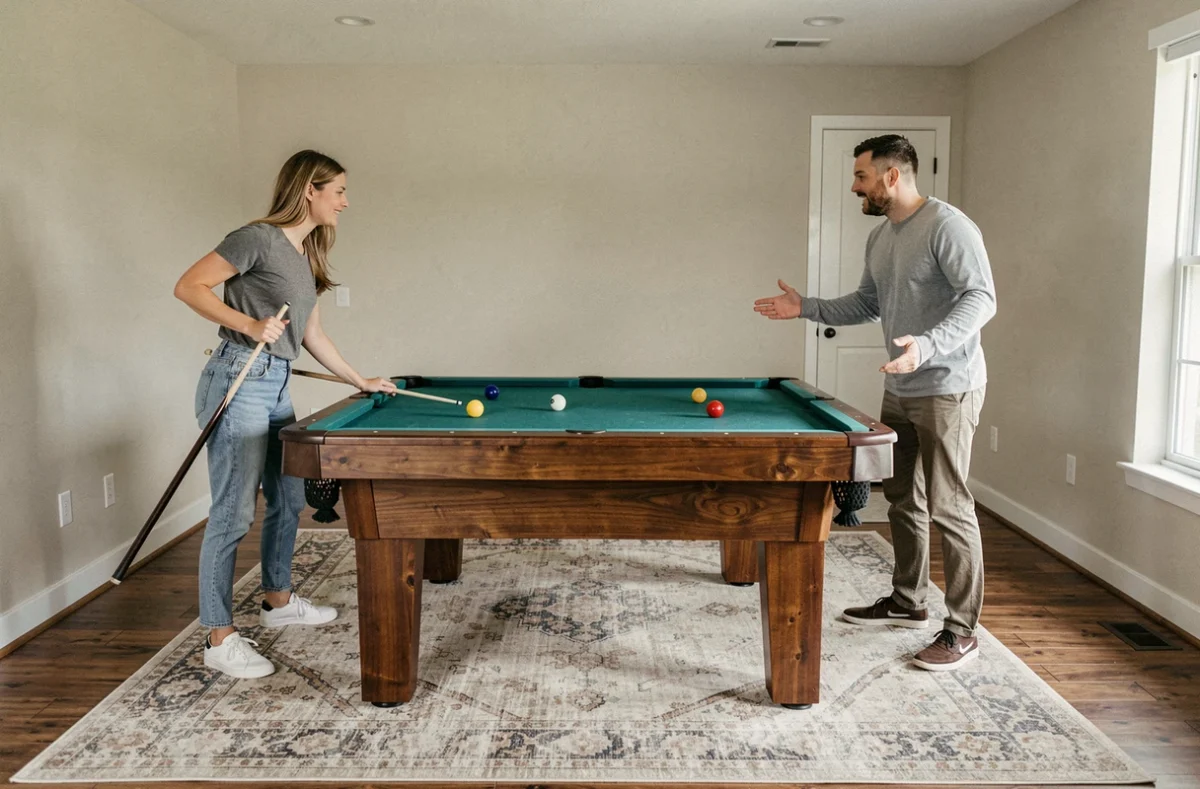
The size of the table is not enough. You also need to add the necessary clearance to take each shot without hitting a wall, radiator, or furniture. The common rule provides for at least 1.30 m of free space around the table to play with a standard cue of about 1.40 m.
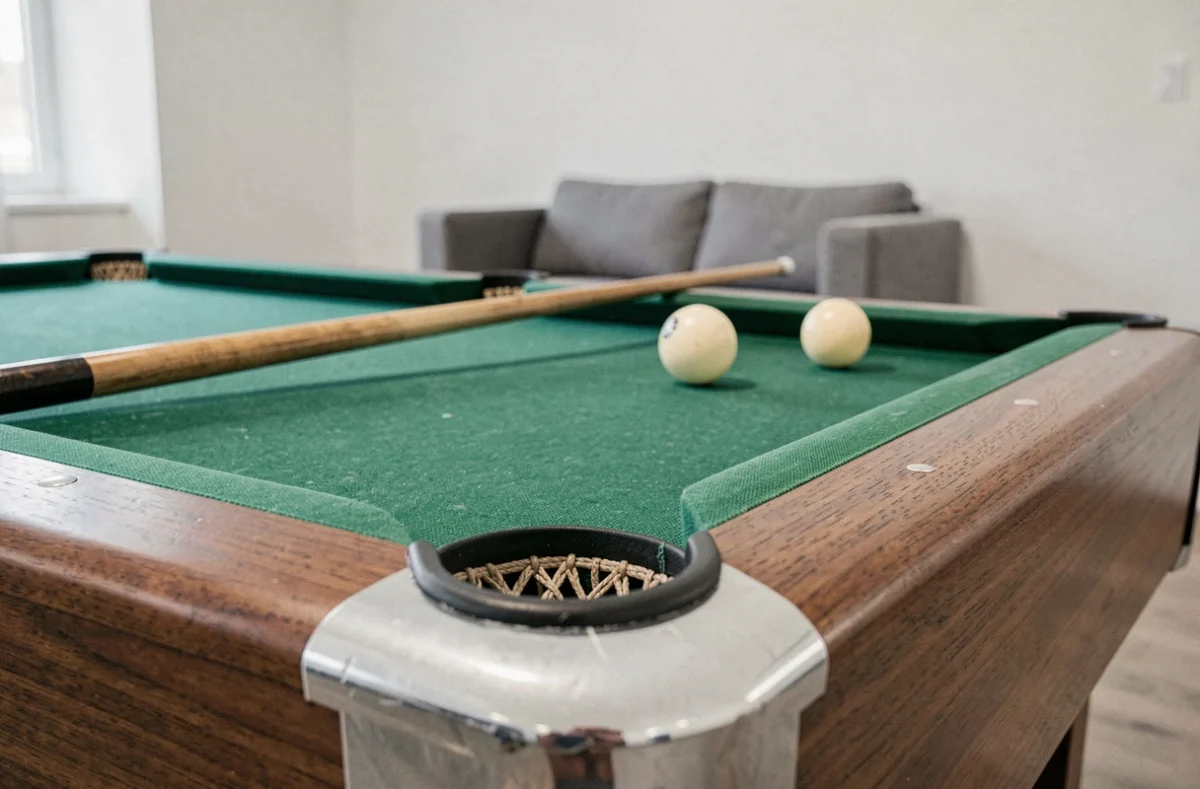
A 220 cm long pool table thus requires a room of at least 480 cm in length and 385 cm in width. For a 240 cm model, count on 500 cm by 395 cm. These values assume a completely clear space, without furniture or obstacles around the perimeter.
Measure the actual clearance, not the theoretical clearance
In a living room, fixed obstacles are plentiful: protruding radiator, load-bearing column, bookshelf, passage to the kitchen. Each reduces the usable clearance on one side of the table. Rather than taking the raw dimensions of the room, measure the actual free area around the intended location, obstacle by obstacle.
If one side of the table is less than 1.30 m from a wall, there are two solutions: move the table to compensate, or use shorter cues (about 1.20 m) on that side. The second option reduces the minimum required clearance, but it alters the comfort of play.
7, 8, or 9 feet format: which American pool table for which living room
The 9-foot table (about 2.80 m) is the competition format. It offers the best quality of play for American pool, but it requires a dedicated room or a very large living area. In a typical living room, this format is rarely compatible with existing furniture.
The choice is practically between the 7-foot and the 8-foot. Here are the criteria that tip the decision:
- The 7-foot is suitable for modestly sized rooms. The playing area remains sufficient for family or friends games, with limited floor space.
- The 8-foot represents the most common compromise for regular home use. It offers superior playing comfort compared to the 7-foot without reaching the spatial requirements of the 9-foot.
- The 9-foot is only justified if you have a room that can accommodate more than 5 meters of free length, and if your play aims for a level close to competition.
The most common format in living rooms remains the 8-foot, which offers a good balance between playing surface and integration into a furnished living area.
Weight and structure: the hidden constraint of installation
Most sizing guides limit themselves to the floor area. The weight of the pool table is, however, a major constraint. Depending on the format and thickness of the slate, the weight of an American pool table can vary considerably, from a few hundred kilos for a compact model to nearly a ton for the largest formats with thick slate.
Three checks are necessary before purchase:
- The load-bearing capacity of the floor, especially on upper floors or on an old floor. A professional can assess whether the joists can support the concentrated load on four legs.
- The delivery route: width of doors, turns in hallways, stairs. A table delivered in several parts (slate separate from the frame) facilitates access.
- The type of flooring. A floating floor reacts differently than a concrete slab under a permanent static load.
Convertible pool table: a format that changes the calculation
The convertible pool table, equipped with a removable top that transforms the game table into a dining table, changes the reasoning. It does not require a dedicated room since it replaces an existing piece of furniture. The clearance remains the same during games, but outside of play, the living room regains its original function.
This format does, however, require planning for the storage of the top and accessories (cues, balls, triangle) nearby. The space-saving is real only if this storage is anticipated.
Check before buying: the actual measurement takes precedence over the catalog
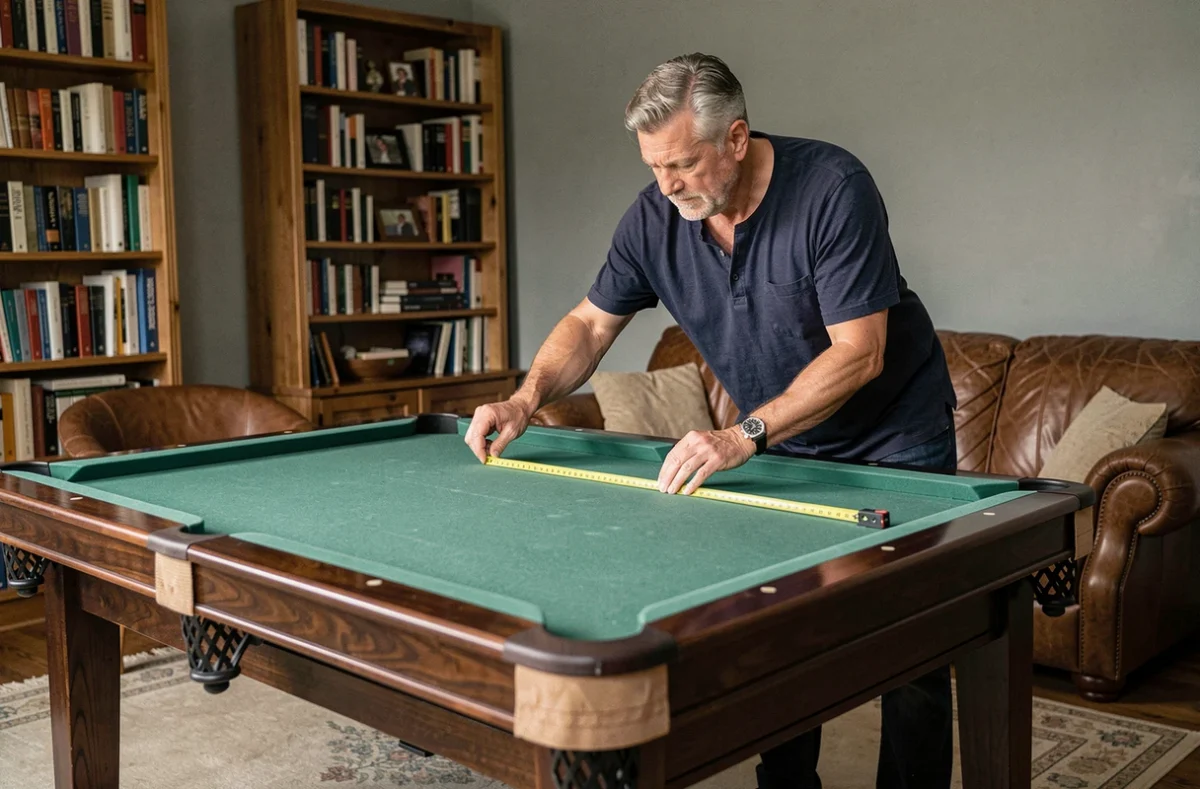
The length of the table in feet, the theoretical clearance, the playing format are starting data. The final decision relies on a physical measurement of your living room, with a tape measure, taking into account each fixed obstacle.
A scaled layout plan, even a rough one, avoids unpleasant surprises at delivery. The American pool table that suits your living room is the one that leaves enough space to play comfortably, not the one that just fits in the room.